Tracing Cross-Provider RNG Certification Protocols and Their Role in Standardizing Hit Frequency Benchmarks for Networked Table Games
Written by Vera Frank · Jul 17, 2026
Tracing Cross-Provider RNG Certification Protocols and Their Role in Standardizing Hit Frequency Benchmarks for Networked Table Games
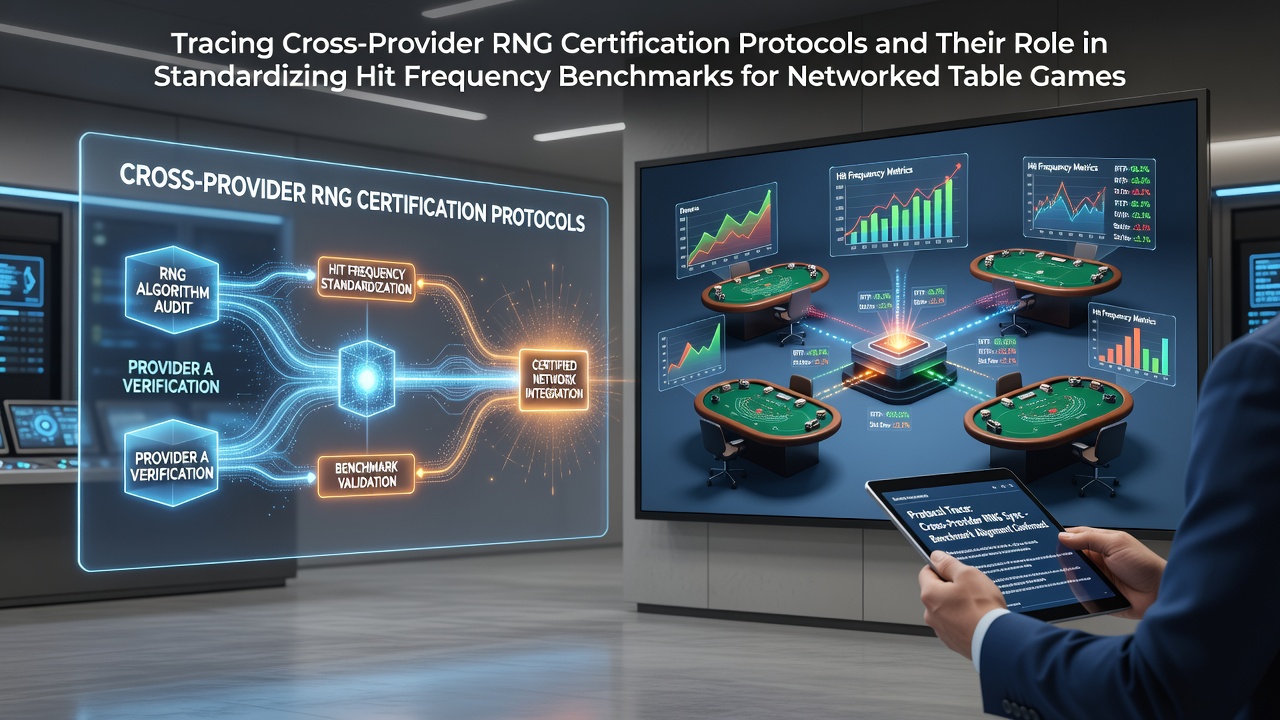
Observers note that random number generator certification has expanded well beyond single-vendor environments since networked table games began linking multiple operators on shared platforms. Protocols now require independent laboratories to verify entropy sources, seed generation, and output distribution before any system connects to live play. These steps ensure hit frequency remains consistent whether a blackjack table runs on one provider's server or draws from several certified pools simultaneously. Certification bodies apply statistical test suites such as diehard, NIST SP 800-22, and AIS 31 across jurisdictions. When a provider submits a new RNG module, labs run at least 10 million sample sequences while checking for bias in card distribution, wheel sectors, and dice outcomes. Results must fall within predefined confidence intervals before the module receives a cross-provider seal. Regulators then reference this seal when operators request interconnection approval for multi-site tournaments or shared progressive jackpots.Mapping Certification Workflows Across Jurisdictions
Procedures differ by region yet converge on common documentation requirements. In Nevada, the Gaming Control Board mandates submission of source code, hardware schematics, and entropy analysis reports before any table game RNG can interface with out-of-state systems. Australian state regulators require equivalent documentation plus periodic re-testing every 12 months. Canadian provincial authorities add a layer that examines failover behavior when network latency exceeds 150 milliseconds, ensuring hit frequency calculations remain stable during reconnection events.
One study conducted by researchers at the University of Nevada examined 47 networked table game deployments between 2023 and 2025 and found that certified RNG modules produced hit frequency variance below 0.8 percent across all connected sites once initial synchronization completed. The same report highlighted that uncertified modules showed deviations up to 3.4 percent during peak traffic periods, prompting several operators to delay launch until full certification cleared.
Standardizing Hit Frequency Benchmarks
Hit frequency benchmarks define the expected interval between winning outcomes for each game variant. Networked environments demand tighter tolerances because players can switch tables mid-session without leaving the platform. Standards organizations publish reference tables that list acceptable ranges for blackjack, baccarat, and roulette variants when multiple RNG sources feed the same virtual table.
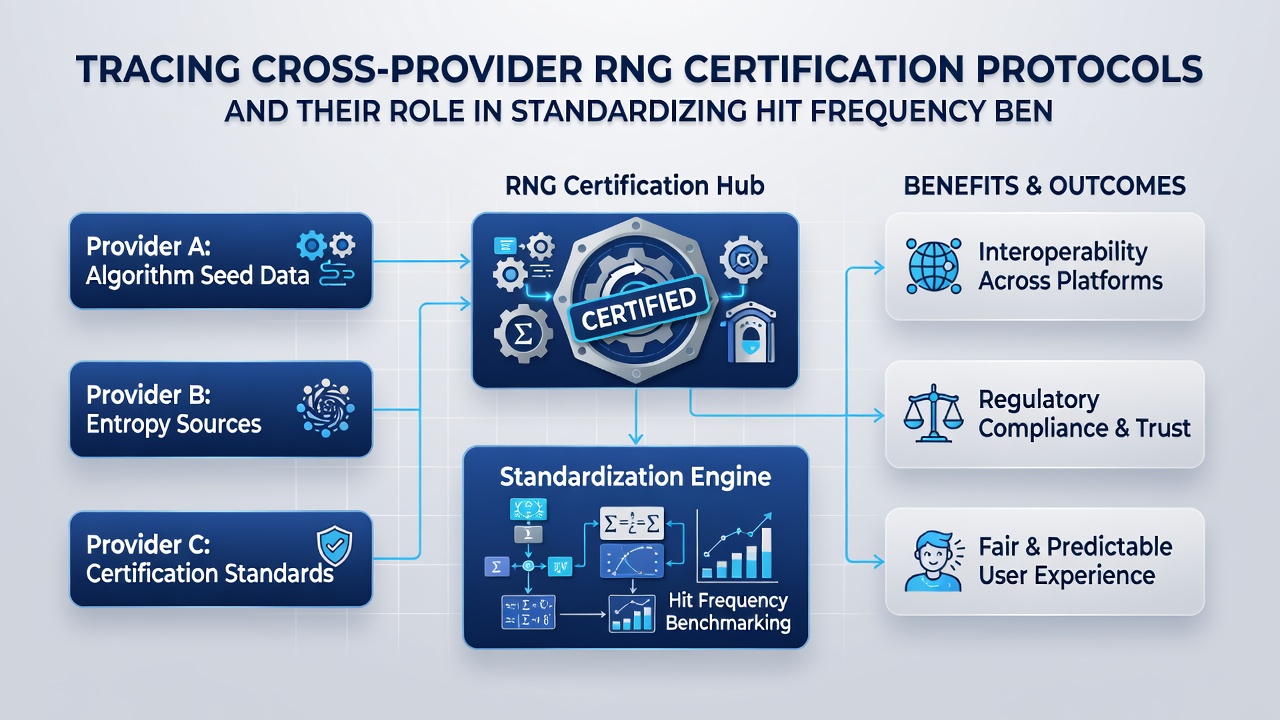
Certification protocols translate these benchmarks into measurable test cases. Labs simulate 500,000 hands while logging every outcome against the published range. Any deviation triggers a re-evaluation of the seeding algorithm or the post-processing filter that converts raw random bits into game symbols. Once benchmarks pass, the protocol issues a digital certificate that includes the exact version hash of the RNG binary, preventing silent updates from altering frequency characteristics.
July 2026 Implementation Updates
By July 2026 several multi-state operators completed migration to a unified certification ledger maintained by the International Association of Gaming Regulators. The ledger records each RNG certificate, its expiration date, and the specific hit frequency ranges approved for live use. Operators query the ledger through an API before allowing a new table to join an existing network, reducing the risk of mismatched benchmarks that could affect session integrity.
Data from the first quarter of 2026 shows a 27 percent reduction in player disputes related to outcome frequency after the ledger went live. The same figures reveal that average certification turnaround time dropped from 19 days to 11 days once standardized templates replaced jurisdiction-specific forms.
Technical Components of Cross-Provider Verification
Verification routines examine both the entropy source and the deterministic post-processing steps. Hardware entropy collectors must demonstrate minimum entropy rates of 0.95 bits per sample under sustained load. Software-based collectors undergo additional scrutiny of their reseeding intervals and state storage mechanisms. When two providers combine outputs, the protocol requires an additional mixing function whose output passes the same statistical battery before distribution to game clients.
Networked table games also incorporate heartbeat checks that compare local RNG output against a reference stream generated by a third-party monitor. If hit frequency drifts outside the certified window for more than 30 seconds, the system isolates the affected table and notifies compliance staff. This mechanism has prevented several potential frequency anomalies from reaching players since its introduction in early 2025.
Conclusion
Cross-provider RNG certification protocols have become the backbone of consistent hit frequency delivery across networked table games. By enforcing uniform statistical thresholds, shared ledgers, and real-time monitoring, regulators and operators maintain outcome integrity regardless of how many independent systems contribute to a single session. Continued alignment among testing laboratories and regulatory bodies supports stable benchmarks as network scale increases through 2026 and beyond.