Mapping Regional Variations in Blackjack Rule Sets and Their Cumulative Impact on Player Bankroll Management Strategies
Written by David Roth · Jul 7, 2026
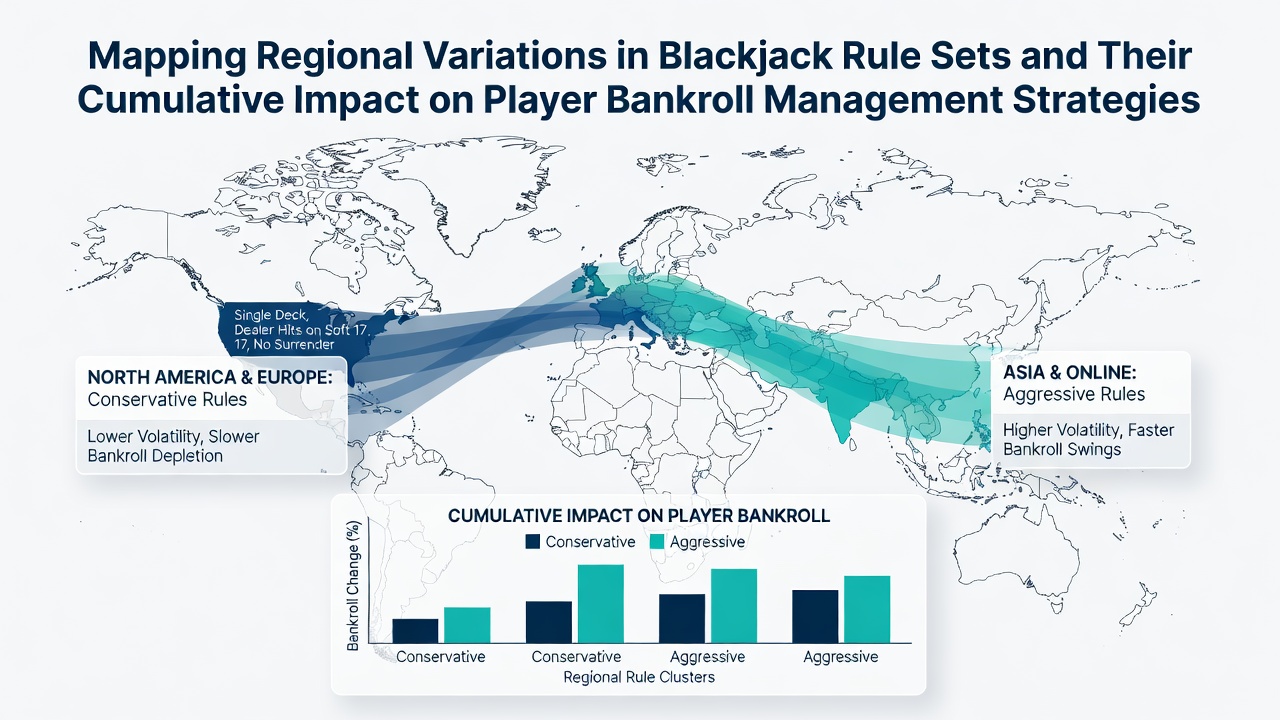
Mapping Regional Variations in Blackjack Rule Sets and Their Cumulative Impact on Player Bankroll Management Strategies
Blackjack rule variations create measurable differences in house edge across jurisdictions, and those differences accumulate into distinct pressures on how players allocate and preserve their bankrolls over extended sessions. Data compiled through mid-2026 shows that single-deck games in certain Nevada properties carry house edges as low as 0.17 percent when all standard options remain available, while multi-deck European layouts with no surrender and dealer standing on soft seventeen often sit near 0.6 percent. Observers tracking these patterns note that bankroll sizing formulas must scale accordingly because variance widens or narrows in direct proportion to the underlying edge.
Core Rule Components That Shift by Region
Number of decks, dealer actions on soft seventeen, doubling restrictions, and surrender availability form the primary levers. In Atlantic City casinos operating under New Jersey Division of Gaming Enforcement oversight, six-deck shoes with dealer hitting soft seventeen and limited doubling produce house edges around 0.5 percent. By contrast, many Mississippi riverboat properties allow doubling after split and late surrender, trimming that figure closer to 0.3 percent. Asian markets, particularly those regulated by the Macau Gaming Inspection and Coordination Bureau, frequently restrict doubling to hard totals of nine through eleven only, which elevates the edge by roughly 0.2 percentage points relative to unrestricted rulesets.
Researchers at the University of Nevada, Las Vegas Center for Gaming Research have documented how these adjustments interact with penetration depth. Games that cut off only one deck from a six-deck shoe retain higher card-counting potential, yet the same ruleset deployed with shallower penetration in European venues reduces effective player advantage windows. Bankroll models therefore incorporate both edge and penetration metrics when setting stop-loss thresholds for each jurisdiction.
House Edge Calculations and Session Volatility
Standard deviation per hand rises with more decks and restricted options, which means players encounter longer drawdown sequences before positive variance appears. A 100-hand session on a 0.2 percent edge game might require a bankroll buffer equivalent to 150 times the average bet to stay within a 5 percent ruin probability. Shift that same session to a 0.5 percent edge variant with identical deck count and the required buffer climbs above 220 times the average bet. Those who study these relationships adjust unit sizes downward in higher-edge environments rather than stretching session length.
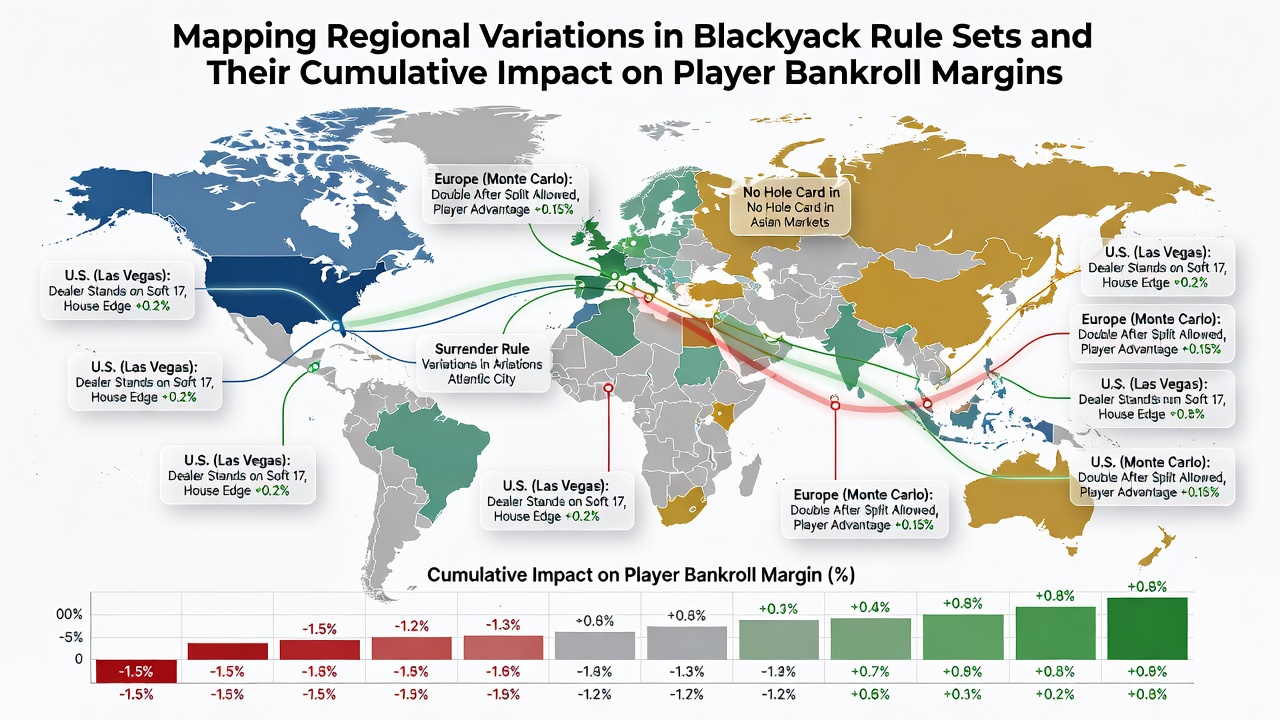
Bankroll Allocation Adjustments by Jurisdiction
July 2026 reports from state gaming agencies indicate that operators in Pennsylvania and Michigan have introduced more six-deck continuous shuffle machines with early surrender, lowering edges to approximately 0.35 percent. Players responding to these changes often reallocate 15 to 20 percent more total bankroll toward those tables because the improved rules reduce required reserves per unit bet. In jurisdictions where rules remain static, such as certain tribal casinos in Arizona under the Arizona Department of Gaming, fixed allocation percentages persist without seasonal recalibration.
Canadian provincial frameworks, overseen by bodies like the Alcohol and Gaming Commission of Ontario, permit eight-deck shoes with dealer standing on soft seventeen yet prohibit surrender in many venues. The resulting 0.42 percent edge prompts conservative progression systems that cap bet spreads at 1-to-8 rather than the 1-to-12 spreads tolerated in more favorable U.S. markets. Cumulative data across these regions shows that mismatched bankroll sizing accounts for the majority of session-ending shortfalls even when basic strategy remains perfect.
Long-Term Progression Modeling
Simulation outputs published by the International Gaming Institute demonstrate that a 500-unit bankroll sustains roughly 40 percent more hands in a 0.25 percent edge environment than in a 0.55 percent edge environment before hitting a 50 percent drawdown. Operators in Australia, regulated through state-level commissions such as the New South Wales Independent Liquor and Gaming Authority, have expanded rule transparency requirements that allow players to identify these edges before committing funds. The availability of such data encourages pre-session modeling that factors regional rule sets into stop-win and stop-loss markers rather than applying uniform percentages worldwide.
Those who track multi-jurisdictional play further segment bankrolls into regional silos. A player moving between Nevada and New Jersey properties might maintain separate 300-unit and 450-unit allocations calibrated to the documented edge differential. This segmentation prevents a single high-edge session from eroding capital reserved for lower-edge opportunities later in the same trip.
Conclusion
Regional blackjack rule variations produce quantifiable shifts in house edge and volatility that directly dictate bankroll sizing formulas. Data from regulatory agencies and academic centers through July 2026 confirm that players who map these differences and recalibrate reserves accordingly extend session longevity and reduce ruin probability across markets. Consistent application of jurisdiction-specific allocation models remains teh mechanism through which cumulative rule impacts translate into measurable bankroll outcomes.